
Measuring a university’s impact is an architecture problem
Universidad San Sebastián brought me in as an external consultant with a clear request: to find a way to measure the impact of its “third mission” — the work a university does with and for society beyond teaching and research.
The request was framed as a measurement problem. It wasn’t. The university was not short on information — it had a model, a policy, dedicated academics, and years of data from platforms, surveys, and evaluations. What it lacked was an architecture: a shared criterion for ordering what it already had and a way to integrate bodies of evidence that had never been made to talk to one another. Without that, more measurement would only add to the pile.
Before building anything, I asked a preliminary question: is “impact” even the right word? In the strict sense, impact means isolating the effect of an intervention from what would have happened without it — a demanding standard that rarely fits this kind of work. Rather than discard it, I placed it where it belongs: at the far end of a results chain that orders what the third mission produces, from activities to longer-term effects, with indicators whose complexity increases along the chain. Evidence informed these choices; it did not dictate them.
The architecture drew on three bodies of work that are rarely brought together — intellectual capital, implementation science, and theory of change. The first describes the value a university creates as intangible assets — its people, its institution, its relationships. The second separates what is essential and common to every initiative from what is particular to each context, so a single system can measure across all of them without flattening any. The third orders the indicators — and it did not have to be invented: it was already latent in the university’s own policy. Much of the work was making it explicit and giving back to the team, in an ordered form, knowledge they already had.
I delivered a conceptualization of the system, a model, and a set of evidence-anchored indicators.
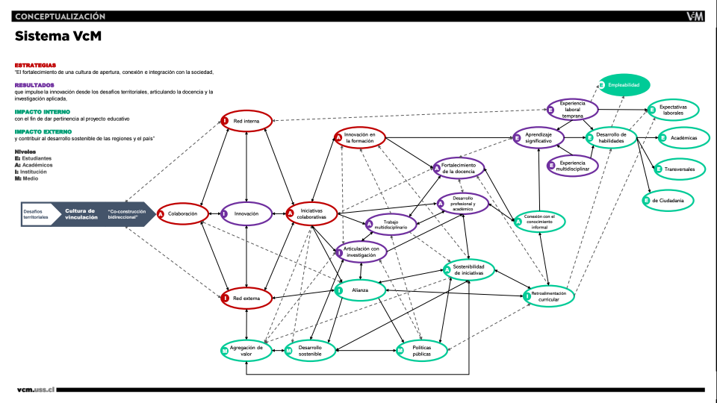
The clearest sign that the approach worked was what happened after I left to join the Ministry of Health: the university carried the process forward on its own and, in 2022, published its own model of contribution. Its acknowledgments name the report I produced as a consultant to the Directorate — Reporte de impacto en la Vinculación con el Medio USS 2020 — as the basis for the model. No dependence on an outside consultant remained; the capacity stayed inside. That was the point.
The subject here was a university, not a health system — but the move was the same one I bring everywhere: the real problem is usually a missing architecture, and building it, not measuring harder, is where the work begins.
The field still lacks a single agreed-upon model for evaluating a university’s third mission, and since 2025, Chilean accreditation has required every university to demonstrate exactly this. Work done in 2020–2021 anticipated what the system now demands.
The contribution model published by Universidad San Sebastián in 2022 names, in its acknowledgments, the 2020 report I produced as a consultant to the Directorate of Vinculación con el Medio as the basis for the model; the university’s 2021 accreditation report also incorporates the work.